
Inside Floyd County Tax Records
Floyd County property tax records divide their work among three offices. Assessment lives in the Floyd County PVA qPublic search. It links each account to a location address. Open a report there and you can read the roll's details. These include the owner, land, improvement, exemption, and value figures. The Sheriff's tax division collects current bills. Once a bill goes delinquent, a certificate passes to the County Clerk. That office handles its collection and sale process.
Each piece answers a different question. The assessment record sets the base through its date and value. A Sheriff payment record shows collection status. A Clerk certificate marks a later delinquency stage. None of these substitutes for a recorded deed. None is an appraisal of what a property might sell for today.
| Tax record field | What it answers | Official keeper |
|---|---|---|
| Assessed value | The PVA value placed on land and improvements for the tax year | Floyd County PVA |
| Exemption | Whether approved tax relief changes the taxable amount | Floyd County PVA |
| Current bill | Amount billed and current-year payment status | Floyd County Sheriff |
| Taxing districts | The jurisdictions whose rates contribute to the bill | Sheriff tax record |
| Delinquent certificate | An unpaid bill transferred into the statutory collection process | Floyd County Clerk |
Collection runs wide here. The Sheriff issues more than 25,000 bills across 11 taxing districts. That number measures the scale of collection work in Floyd County, not the tax burden on any single parcel.
Floyd County's January Tax Snapshot
Kentucky sets its assessment date on January 1. Whoever owned the parcel on that morning pays, and that name is printed on the tax bill for the year. That rule can surprise a recent buyer. A transfer recorded in June does not change it. The January owner of record stays on the tax roll until the next cycle. So a deed comparison matters. Before drawing any conclusion about title, match the tax-year owner against the newest recorded deed in the Floyd County deed records.
The valuation standard is fair cash value. In plain terms, that is the price a willing buyer and a willing seller would strike. Neither side is pressured. Both sides know the property's relevant facts. The PVA walks real property on a four-year inspection cycle, and assessments update on that rhythm. Ownership changes and value work do not land on the same day, however. Floyd County's inspected qPublic application publishes no fixed post-closing update interval. The tax bill can therefore lag a fresh sale by months.
Assessed value, market evidence, and sale price are three different numbers. For a closer look, turn to the Floyd County property value record. It sorts out each figure.
Search Floyd County Assessments
Floyd County opens its qPublic search to anyone. A street address or an account number gets you in. Those two routes run free of any login. Owner name, parcel ID, and description modes sit behind a password or subscriber gate instead. For property tax research, use a clean address. A known account number works just as well as the best starting key.
| Search control | Public access observed | Useful format |
|---|---|---|
| Location address | Available | Partial address or a selected autocomplete suggestion |
| Address range | Available | A range such as 1200-1299 Main |
| Account number | Available | Exact-match option is offered |
| Owner name | Gated | Password or subscriber access shown |
| Parcel ID or description | Gated | Use the address/account route or ask the PVA |
A portal tab alone does not prove that every field is publicly readable. Save the account key from a valid result first. Then use that number when you speak with the PVA or the Sheriff's tax desk.
Trace a Floyd County Tax Bill
Run the assessment and collection searches as two linked checks. The Sheriff's property-tax information page links the current vendor portal and lists the tax division contact. The application shell publishes no reliable field inventory, so do not assume a name, address, or bill-number option until the live form displays it.
- Find the parcel in qPublic by location address, address range, or account number. Record the account key and the tax-year assessment.
- Open the Sheriff-linked payment portal and use the search choices the current interface provides. Compare the tax year and parcel identity before relying on a status.
- Read the bill against the PVA record. Check whether an exemption affects the taxable figure and whether the January 1 owner explains a name mismatch.
- If the current portal does not show an older unpaid bill, ask the County Clerk whether a certificate of delinquency was transferred or advertised.
The captured Sheriff-linked 2025 tax portal shows the official payment application's entry shell.
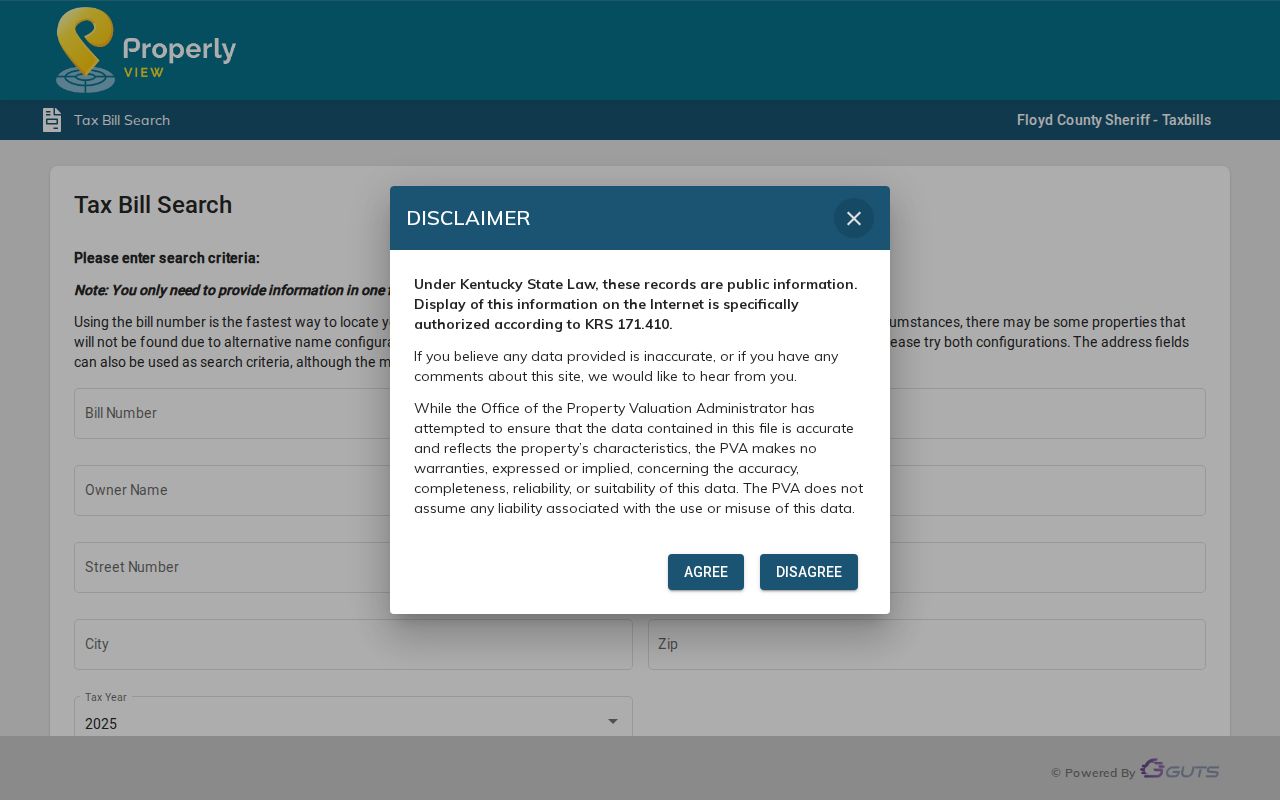
The official collection page confirms the correct county route. The live application remains the source for whatever fields and statuses it displays at search time.
- Assessed value
- The value the PVA places on property for tax administration.
- Levy or tax rate
- A rate applied by a taxing district; the combined bill can reflect several districts.
- Homestead exemption
- Kentucky relief for an eligible owner age 65 or older, or a qualifying totally disabled owner.
- Tax lien
- A legal claim tied to unpaid tax; a delinquent property-tax certificate is a lien on the property.
Floyd County Tax Exemptions
Kentucky's homestead exemption for 2025 and 2026 is $49,100. Owning a home does not make the exemption automatic. The applicant must be at least 65 or qualify as totally disabled under state rules, own and occupy the property, and apply through the Floyd County PVA with the required proof. The PVA staff can confirm exactly which documents to bring and whether the county roll already reflects an approved exemption for the tax year in question.
Other constitutional or statutory exemptions follow different rules. The Kentucky Department of Revenue homestead page gives the current statewide amount and spells out the eligibility route. Exemptions change taxable value only. They do not rewrite the deed, remove a mortgage, or establish who holds title to the parcel.
Review Floyd County Tax Values
The real-property tax roll opens each spring. Public inspection runs 13 days, beginning the first Monday in May, and Floyd County taxpayers who dispute a value must hold a conference with the PVA during that window. Disputes must start there. The conference can be in person, by phone, or by another electronic method accepted under the state process. Bring facts tied to the parcel. Comparable sales, condition photos from the assessment date, measurements, an independent appraisal, or proof of an error in land or improvement data all help. Photos work best when dated to January 1. A bill alone proves no method error. Note: The inspection period is the required first stop, so contact the Floyd County PVA early rather than waiting for a later bill.
Contest a Floyd County Assessment
Deadlocked at the conference stage? The next stop is the Floyd County Board of Assessment Appeals. Kentucky Form 62A301 steers that filing to the county clerk. The deadline is tight: one workday after the inspection period closes. Prepare your evidence in advance. The board can ask for it. Arrive with sales, plats, or appraisal support for the parcel number at issue. Still unsatisfied? A further appeal runs to the Kentucky Claims Commission along the state's track.
Protect the appeal window. Complete the PVA conference during inspection, then file the county-board appeal with the Clerk by the one-workday deadline.
Floyd County owners who disagree with an assessment can turn to the Department of Revenue assessment page, which lays out fair cash value, the inspection process, conferences, and appeals. Property tax records challenges move fast, so confirm the current form and the exact filing calendar before submitting anything to the county.
The state assessment resource referenced above applies to Floyd County property tax records statewide.
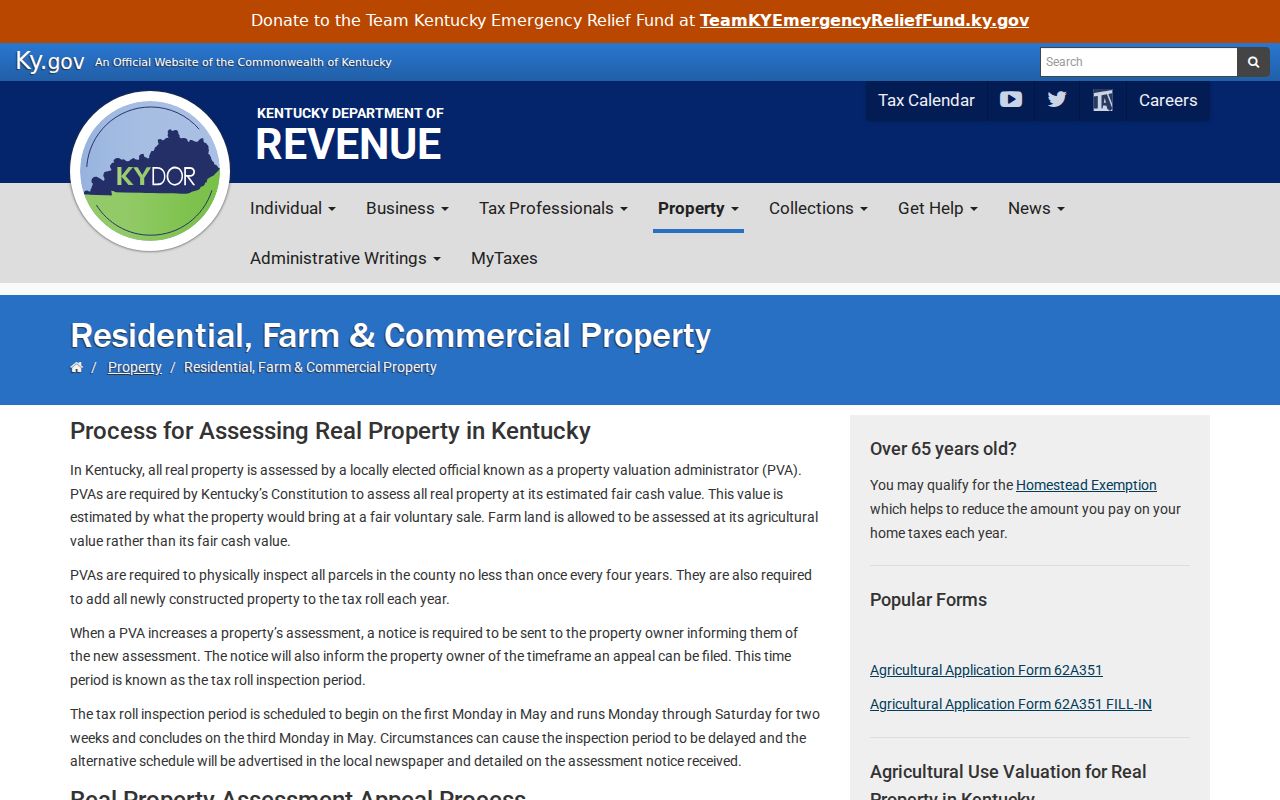
Statewide rules set the framework here. Locally, the Floyd County PVA and the Clerk run the review and handle the filing steps.
When Floyd County Taxes Go Unpaid
The Sheriff's collection window eventually closes. Unpaid Floyd County tax bills then move to the County Clerk. They arrive as certificates of delinquency. Interest, penalties, fees, notice requirements, and third-party purchase rules kick in from there. Here is the key point: buying a certificate buys the tax claim itself. It does not hand over a deed or any right to occupy the land.
The Clerk advertised a September 18, 2025 sale covering 2024 delinquent bills. Treat that as one example of the handoff, not a calendar for future sales. The Clerk's delinquent-tax notice and the current sale guide carry the live event. They also carry the advertised list and bidder rules.
Some parcels are older. Some may be missing from the display. Those call for a direct call or visit to the Clerk. The Kentucky Open Records Act, KRS 61.870 through 61.884, offers a written-request fallback for nonexempt records. It applies within its residency and exemption limits.
Limits of Floyd County Tax Records
Floyd County property tax records prove tax administration facts. They do not prove title. The owner of record on January 1 may not be the recent buyer. A paid bill says nothing about released mortgages or other liens. An assessed value is no substitute for a private appraisal. The tax bill cannot settle a boundary dispute.
Keep the roles straight. The PVA holds the tax roll and values. The Sheriff issues the current bill. The Clerk keeps delinquent certificates. Ownership questions belong with a deed and recorded encumbrance review; a disputed line belongs with a licensed surveyor. Separating those duties keeps one convenient tax screen useful. It was never built to prove those facts.
Date everything you save. Screenshot, receipt, certificate, or appeal paper, note the tax year alongside it. Kentucky's January 1 assessment date, the Sheriff's yearly cycle, and the later shift of unpaid bills all matter. Two accurate Floyd County property tax records can describe different stages of the same parcel. A dated source log keeps a current payment from being mistaken for an old delinquency or a later ownership change.