
What Floyd County Deed Records Transfer
The Floyd County Clerk records several instruments that can transfer or clarify an interest in land. The label on each form matters, because every deed type carries its own promise and purpose.
| Deed Type | What It Does | Common Use |
|---|---|---|
| General deed | Conveys the described interest under its stated covenants | Ordinary transfer |
| Quitclaim deed | Passes whatever title, interest, or claim the grantor has without warranty | Family transfer or chain cleanup |
| Correction deed | Corrects an earlier recorded instrument | Name or description correction |
| Executor, trustee, or descent instrument | Documents an estate or fiduciary transfer | Property passing at death or through a trust |
| Deed of easement | Creates or conveys a defined use right | Access or utility rights |
Not every recorded document conveys ownership. A mortgage or lien is an encumbrance. A release clears a recorded claim. Automated general indexes can mix instrument types under a single party name. Read the instrument type before drawing any conclusion about a Floyd County parcel.
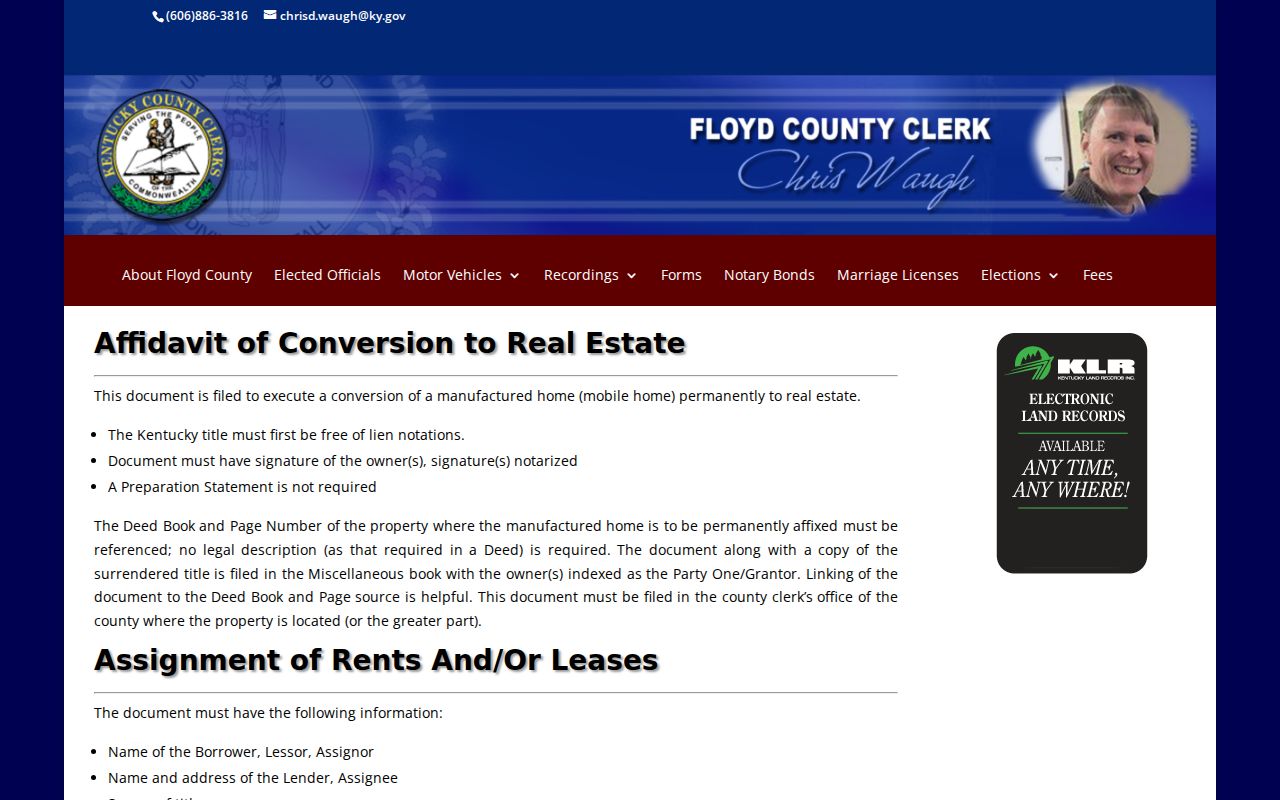
Floyd County recording vocabulary extends well beyond an ordinary sale. An affidavit of descent may explain an estate transition. An affidavit of conversion to real estate can document a manufactured-home change. Powers of attorney and deed restrictions can affect a transfer. Leases, contracts, fixture filings, and tax certificates can too. Search the instrument term that fits the event instead of limiting the request to the word "deed."
The Floyd County Clerk Records the Deed
The Floyd County Clerk recording division is the official county custodian of deed records. A Kentucky deed must identify the grantor and grantee mailing addresses, consideration, a legal description, source of title, a preparation statement, a return address, and the in-care-of tax-bill address. The grantor signs before a notary. The consideration statement is notarized as well. The official deed page spells out these requirements in full.
Use this checklist when a document comes back rejected, or when an abstract lacks the party, description, or source-of-title detail needed to follow the chain of title.
Search Fields for a Floyd County Deed
The Floyd County Clerk publishes no online deed-index search form. The Clerk's pages explain recording requirements, but the current web index, image cutoff, and document-number fields are best confirmed by asking the office directly. Request the permanent office index rather than assuming any vendor platform covers Floyd County deed records.
| Index detail | What to preserve | Why it matters |
|---|---|---|
| Grantor and grantee | Exact name, initials, entity or fiduciary form | Builds the party chain |
| Instrument type | Deed, correction, easement, release, mortgage, lien | Separates transfers from claims |
| Book, volume, page | Full recording reference | Locates the instrument image or copy |
| Instrument and recording dates | Both dates when available | Orders execution and public recording |
| Description or location | Tract, lot/block, acreage, watercourse | Confirms the same land |
Kentucky's retention schedule makes the General Index to Deeds permanent and unrestricted. That permanence makes the Clerk counter a valid fallback even without an online search box.
At the counter, search in both directions. A direct index starts with the grantor. A reverse index starts with the grantee. Ask the Clerk how Floyd County labels those indexes. Also ask whether the relevant volume sits on paper, microfilm, a terminal, or an image system. Keep the index citation even when no image is available. It identifies the next copy request.
Search dates and recording dates can differ. Preserve both when the index supplies them. Order transfers by the recorded evidence without assuming that a late recording resolves every priority question.
Walk Floyd County Grantor-Grantee Names Backward
The current assessed owner can seed a chain, but the newest deed is the safer starting document. Match its legal description to the tract. Then move backward through the Floyd County deed records one transfer at a time.
- Find the current party as grantee and open the deed by which that party acquired the tract.
- Read the grantor, legal description, source of title, instrument date, and recording reference.
- Search that grantor as a grantee in an earlier deed. Confirm the same description before accepting the link.
- Repeat through correction deeds, estate instruments, and name variants. Shift to deed books or microfilm when the index route stops.
- Grantor
- The party transferring an interest.
- Grantee
- The party receiving the interest.
- Chain of title
- The ordered series of instruments linking interests in the same land.
- Book/page
- A volume and page reference used to locate a recorded item.
Floyd Deed Fees and Transfer Tax
The Clerk's published fee schedule took effect January 1, 2020. It lists a deed at $50 and a correction deed at $46. An easement runs $50. A mortgage is $80, a release is $46, and a plat is $50. Many instruments add $3 per page after the first five. The mortgage rule uses a different threshold after 30 pages. Confirm the current total before filing or ordering anything.
KRS 142.050 imposes a transfer tax of $0.50 for each $500 of value or fraction. The grantor pays it unless an exemption applies. Gift or nominal-consideration transfers can require a sworn fair-cash-value statement. Consideration is a recorded transaction clue, not proof of current market value.
Mortgages, Releases, and Floyd Easements
Floyd County deed records sit within a larger instrument trail. Mortgages, assignments, vendor liens, releases, lis pendens, judgment liens, leases, contracts, powers of attorney, and fixture filings can all appear under the same parties. An easement is indexed under both parties and every affected parcel.
A release should identify the releasing and released parties. It should also cite the mortgage or vendor-lien reference. A partial release also needs a legal description. Read these items beside the transfer deed to see what was created, changed, or cleared. Never call the lienholder an owner of record.
Note: A recorded lien is notice of a claimed interest. It is not proof that every allegation behind the filing is valid.
Plats Support Floyd County Deed Records
A deed description may refer to a subdivision plat. It may also cite a lot and block or a metes-and-bounds tract. The Clerk's plat guidance requires a planning-commission plat to carry signed and dated approval. It must include surveyor certification and seal. Maximum size is 24 by 36 inches.
Older Floyd County descriptions often rely on creeks, branches, hollows, and roads. They may also reference rail lines or neighboring tracts. Compare those clues with the qPublic GIS map. But do not substitute the GIS polygon for the recorded description or a current survey. A plat helps locate the land while the deed establishes the transfer instrument.
Floyd Deed Books After the Fire
Floyd County took shape in 1800. Its first courthouse burned on April 8, 1808. The Clerk reports that the fire destroyed early records, so the oldest government-activity material does not predate the loss. A pre-1808 gap may point you toward predecessor-county deed books or state land-grant files.
Later holdings run deeper. A library catalog lists Floyd County deed books from 1810 through 1901 and a deed index from 1810 through 1969. Those dates cover cataloged microfilm and finding aids, not a complete open online image set. FamilySearch catalog notes, KDLA, the Clerk counter, and the Floyd County Public Library newspaper archive can supply older names and references.
Boundary change can move the next link outside Floyd. Floyd formed from Fleming, Montgomery, and Mason parts. Later county lines split territory once recorded in Floyd. When a surname search stalls, search a watercourse, survey, land warrant, patent, and adjoining owner instead. Creek and branch names outlast postal places.
Get a Floyd County Deed Copy
Start with the Floyd County Clerk. Find it at 149 S Central Avenue in Prestonsburg. Give the grantor, grantee, and approximate date. Add the instrument type, property description, and book/page when known. Ask whether the page is available as an office copy, a certified copy, or through a confirmed electronic service.
The county publishes no exact Floyd online-image fee or web-index cutoff. eCCLIX sells paid Kentucky access through a public-account signup. The county's own availability listings do not confirm Floyd, so verify before paying. Older requests can go to KDLA, which publishes a $20 in-state and $25 out-of-state search fee plus possible copy costs and a four-to-six-week turnaround.
Say whether the copy must be certified. A useful request names Floyd County, both parties, the deed type, a narrow date range, book/page or instrument number, and a legal-description clue. Know only an index entry? Ask the office to quote the charge first. The recording fee schedule covers filing costs, not the certified-copy price.
Recorded, not guaranteed. Floyd County deed records show instruments accepted for recording. They do not reveal every unrecorded interest or supply a title opinion, so obtain professional title work before relying on a chain.
Floyd Property-Fraud Alert Status
Floyd County publishes no property-fraud alert signup of its own on the Clerk, Sheriff, or PVA sites. Do not enroll through an unrelated county. A vendor notice elsewhere does not cover Floyd owners either.
Call the Clerk at 606-886-3816 and ask whether a new alert service, vendor option, or in-office monitoring method exists. Keep the exact recorded name and tract reference handy, then check the index for unfamiliar deeds, liens, or powers of attorney. Report a suspected forged or groundless filing to the proper public office rather than confronting a named party from the index.