
Floyd County Owner Record Card
Start with the Floyd County PVA parcel report. It is the fastest way to find the current owner of record. It lists the assessment name, mailing and situs addresses, account or parcel ID. It also covers the legal description, last-sale details, deed reference, assessment year, and upload date. No sample card is published, so field labels vary slightly. The parcel number is the key to pulling it all up.
| Assessment name | Present owner lead on the PVA roll |
|---|---|
| Mailing address | Where tax notices are sent |
| Situs address | Where the parcel lies |
| Last sale | Date and consideration clue, when reported |
| Deed reference | Link to recorded proof |
| Parcel key | Account identifier shared with the map |
The assessment name is not an occupant. It identifies the taxpayer of record. A notice address can lie outside Floyd County entirely. To verify the current owner, use the deed reference and the legal description rather than treating a mailing address as proof.
Floyd County Owner Portal Access
The Floyd PVA qPublic application lets the public search by location address. It also accepts an address range or account number. Owner-name, parcel-ID, and description searches sit behind a subscriber login. An address or account number is therefore the practical starting point. The official Floyd qPublic screen displays those public search options directly. The portal shows an upload date for its data. The PVA publishes no stated refresh cycle or normal closing-to-roll delay.
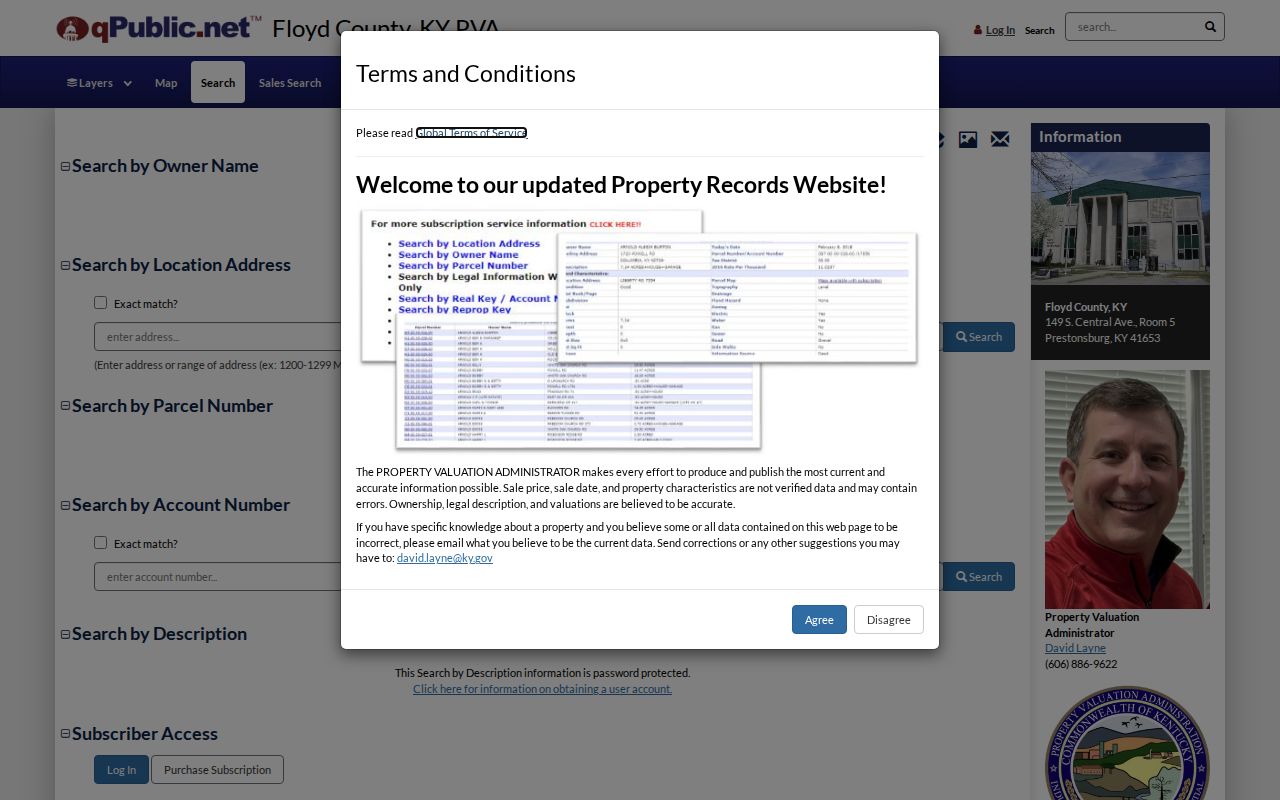
The image documents the access route, not a result for a named parcel.
Time the Floyd County Owner Record
Kentucky assessments hinge on January 1. That date fixes the assessment year's owner of record. A buyer and seller may split taxes by contract. Yet the annual tax bill can still name the January 1 owner or an in-care-of notation. Closing, recording, PVA processing, and tax mailing are separate events. A freshly signed sale may not appear on the current roll. Check the recording date on the latest deed. Ask the PVA about pending processing whenever the closing is recent.
Note: Floyd County publishes no standard roll lag, so do not promise that a new owner will appear within a set time.
Confirm Floyd County Ownership Now
An ownership check starts with the parcel and ends with the latest recorded instrument. The Floyd County Clerk deed guidance spells out the required recording fields. That list includes grantor, grantee, consideration, legal description, source of title, preparation statement. It also covers the tax address. Each field ties the deed back to the PVA record.
- Locate the parcel by address or account and record the assessment name.
- Match the parcel key, legal description, and map position.
- Find the newest deed or order and read its grantee and source of title.
- For an entity, compare its exact name with the Kentucky business filing.
- Owner of record
- The party named in the public ownership trail.
- Assessment roll
- The PVA record used to assess parcels.
- Situs
- The physical location of the land.
- Recording lag
- Time between closing, recording, and a roll update.
Check Floyd County Entity Owners
An LLC can be the current grantee. A trust may be indexed under a trustee or trust title. An estate may use a decedent or fiduciary name. Preserve punctuation, initials, and role words exactly. The Kentucky business entity search then adds filing and registered-agent context. A state filing does not prove parcel ownership, though. The newest deed must carry the matching name and legal description. Probate records may explain authority, but the recorded land instrument remains the ownership link.
Verify Floyd County Owner Records Offline
When qPublic is unavailable, call the Floyd PVA at 606-886-9622 or mapping at 606-886-6257. The office sits at 149 S Central Avenue, Room 5, Prestonsburg. Ask for the parcel report. Ask for its data year and the deed reference too. The Clerk site publishes no open deed index. Use the counter, a focused records request, or eCCLIX once Floyd coverage is confirmed. Deed indexes retained permanently remain the fallback when the web route fails.
Freshest lead. A recent recorded deed is stronger evidence of the present owner than a roll that has not processed the sale.
Compare Floyd County Owner Addresses
The owner of record's mailing address can differ from the situs. Notices may go to a remote owner, trust, company, or fiduciary. Vacant land can lack a normal house number. None of that changes where the parcel lies. Floyd County hollows, creeks, roads, and valley names matter where modern addressing is weak. Compare the deed against qPublic roads, streams, parcel numbers, and aerial views. Never resolve a same-name collision from a surname alone. A tax bill may preserve the January 1 assessment name even after a later deed places the property in a new name. The in-care-of tax address can hint at a transition. It still cannot replace the grantee and legal description on the recorded deed.
Match Floyd County Owner Deed Fields
A Kentucky deed presented to the Floyd County Clerk identifies the grantor and grantee with mailing addresses. It states consideration and describes the land. The document also cites the source of title, and it carries preparation, return, and tax-notice information. The in-care-of address has been required on deeds since August 1, 2008. Those details distinguish two owners with similar names. They also tie a current-owner claim to one specific tract. Read the deed type, not just the names. A correction deed can repair an earlier record without marking a new market sale. A quitclaim passes whatever interest the grantor holds, with no warranty behind it. A court-ordered or estate transfer can also install a current grantee without a conventional purchase. Keep that context as part of any owner-of-record check against the tax roll.
Keep Floyd County Owner Liens Separate
A mortgage, judgment lien, tax lien, lis pendens, or easement can attach plenty of names to a parcel. None of them is the owner by default. The Clerk indexes easements by party and by parcel. A lis pendens only signals that litigation might touch the title. Treat each as an encumbrance clue. The vesting deed still settles who holds title.
Recent disputes, releases, and foreclosures call for a closer look. Read the recorded sequence in order. Pull any Floyd Circuit Court file that affects title. A lender or plaintiff can hold a real legal interest while the owner of record stays someone else entirely. Label every role clearly. That keeps debt and litigation from blurring into ownership on your record card.
Use Floyd County Owner Data Lawfully
A public mailing address is a notice channel. It is not an invitation to intrude. Floyd County owner records earn their keep in purchase diligence, boundary talks, estate work, and fraud review. They say nothing about occupancy. Kentucky Safe at Home can swap in a substitute address across many records, though real-estate holdings may stay public. Confirm anything material with the PVA and the Clerk, respect redactions, and if you must contact someone about a property matter, use the published mailing route with a clear, limited message.
Open records: a Kentucky resident may request an existing nonexempt local record under KRS 61.872 when the portal leaves it out. Name the parcel, document type, names, and date range. Protected material stays withheld. Nonexempt parts of mixed records must be separated where the law requires.
Preserve the date behind every ownership conclusion. Save the PVA upload clue, the assessment year, the deed recording date, and the day an office confirmed the result. If the deed and the tax roll disagree, state that conflict plainly. Ask both offices to reconcile it. Never just pick the more convenient name.
Tax status does not settle ownership. The Sheriff collects current bills. Delinquent certificates move to the County Clerk. A paid bill proves an account was paid, not who took title in a later transfer. A tax lien, likewise, names an obligation. Do not confuse it with the grantee on the newest deed.
Court files: when a foreclosure, partition, quiet-title action, or probate order affects the current record, the Floyd Circuit Clerk can supply the file. Read the final order first. Then find the recorded instrument that applies it to the parcel.
Lawful use. Never use Floyd County current owner information to stalk, harass, intimidate, or harm a person.