
Compare Floyd County Value Types
Several numbers can describe a single parcel. Each answers a different question, because the PVA assessment rarely equals the last sale, and deed consideration is not always an arm's-length price.
| Value | What It Is | Where |
|---|---|---|
| Assessed value | PVA value for tax administration | Parcel report |
| Fair cash value | Kentucky fair-sale estimate | PVA framework |
| Last sale | Amount tied to a transfer | Deed or sales history |
| Land vs improvement | Parts of the total | Parcel report |
Kentucky assesses real property at estimated fair cash value rather than publishing a fractional residential ratio. Floyd County publishes no separate ratio, and agricultural land may qualify for agricultural-use treatment.
Read Floyd County Value Components
Check land, improvement, total, year, and exemptions. The parcel key anchors it all. Open the official Floyd report tab to read the acreage, the sale fields, and the exact labels the county uses.
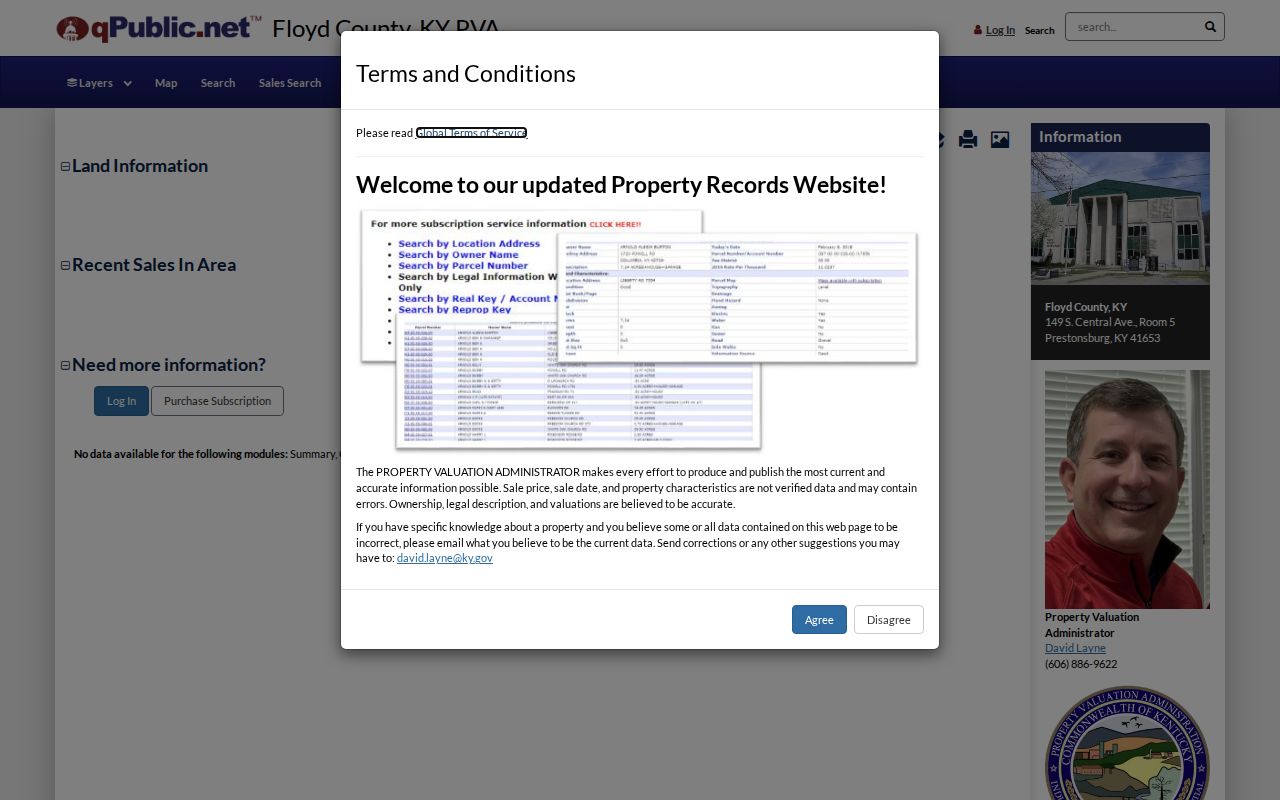
The capture documents the report route, while a parcel result remained unavailable.
Define Floyd County Fair Cash Value
Kentucky defines fair cash value through an estimated fair voluntary sale. The PVA does not appraise one site. It runs mass appraisal across many parcels. No fractional ratio applies in Floyd County. Agricultural classification can create separate use treatment, so compare values only after confirming the parcel, the year, and the class.
Estimate Floyd County Value Records
Address, range, and account searches are public. Use the Floyd qPublic search; other modes stay subscriber protected.
- Search the address or account.
- Confirm situs, acreage, map, and description.
- Record land, improvement, total, exemption, and year.
- Check the deed separately for consideration.
- Assessed value
- The value carried by the PVA.
- Market value
- An estimate of a fair-sale price.
- Assessment ratio
- The relation of assessed to market value.
- Consideration
- The amount stated for recording.
Time Floyd County Property Values
Kentucky assesses real property as of each January 1. The state also requires a physical inspection at least once every four years. May opens a 13-day roll inspection window. Comparisons can mislead when one parcel was just reclassified, improved, or inspected. Another may have sat untouched. qPublic shows a September 9, 2026 upload timestamp. It publishes no refresh policy. Treat the stamp as a clue, not proof that every value changed that day. Record the assessment year on the parcel report. Ask the PVA when a figure looks out of sequence.
Compare Floyd County Value Records
Deed consideration is not always market price. Gifts, family transfers, divorce orders, corrections, and exempt instruments make poor benchmarks. Kentucky transfer tax runs on stated value. That calculation never turns a transfer into an open-market sale. Match the date, legal description, and parcel. A stale or non-market transfer should not be the sole estimate of present worth. qPublic exposes separate sales tabs. Neither number proves present worth by itself. Work from qPublic's separate sales tabs. Do not guess at comparable-sale fields the county does not show.
Separate Floyd County Taxable Value
An exemption trims the tax base without rewriting the assessment. Kentucky's homestead and disability exemption stood at $49,100 for 2025 and 2026. It is subject to proof and eligibility. Agricultural-use treatment and other constitutional or statutory exemptions follow their own rules. Different taxable amounts do not mean different market values. Compare land, improvement, total assessment, exemption, and taxable figure as separate fields. The Floyd Sheriff's tax bill is a collection record. The PVA report is the valuation record.
Place Floyd County Values in Context
Postal cities and municipal lines do not match. Prestonsburg annexations, Martin filings, and Wheelwright boundary changes make location checks essential. Hollow, creek, and corridor settings can shape use too. The qPublic viewer layers parcels, parcel numbers, address numbers, roads, streams, city labels, and county outlines over 2008 and 2022 aerial imagery. Check context there before comparing anything. Proximity alone never makes a comparable. Match use, acreage, access, improvements, and assessment year before drawing a value conclusion.
Split Floyd County Property Value
The land component values the site apart from structures. The improvement component covers assessed building value. The total combines both under the parcel record. That split can explain why two neighboring parcels carry different assessments even when their acreage looks alike on the map. Building characteristics, sketches, and acreage belong beside the value fields whenever available. Do not assume exact building labels or valuation formulas. Ask the PVA to clarify any component that is absent or inconsistent.
Verify Floyd County Values at PVA
When qPublic returns nothing usable, call the Floyd County PVA at 606-886-9622. Mapping questions go to 606-886-6257. The office sits at 149 S Central Avenue, Room 5, Prestonsburg. Give staff the address, account number, and legal-description clues. Do not ask them to pick among same-name parcels. Open-records procedures can support a focused request. The office must produce an existing nonexempt record, but it need not create a new appraisal or comparison. Ask for the parcel record, the relevant assessment year, and any existing value-history fields.
Read Floyd County Recorded Value
Floyd County deeds carry a consideration figure for a reason. The County Clerk requires it on every recording. Gift or nominal transfers need a sworn fair-cash-value statement unless an exemption applies. Kentucky also charges transfer tax at fifty cents per five hundred dollars of value or fraction, so the amount on a deed reflects recording requirements rather than proof of an open-market sale.
Treat the deed amount as one dated data point. Weigh it against the PVA assessment year and any verified sales history before drawing conclusions. Correction deeds, government rights-of-way, cemetery lots, some divorce-ordered transfers, and listed easements follow special rules. A simple price comparison across those cases can mislead.
Know Floyd County Value Limits
An assessed value in Floyd County is a tax figure. It is not a sale price, survey, title opinion, or parcel appraisal. The same property can carry an assessment, a taxable amount after exemptions, and a deed consideration. No record is wrong in that situation. Each figure answers a different question. The Floyd PVA owns assessment values. The Sheriff handles current collection. The County Clerk records deeds and later receives delinquent certificates. Before relying on a number, confirm the parcel number, year, class, and exemptions. For a real transaction, compare verified sales and get an appraisal when one is needed.
The four-year physical inspection cycle does not mean a parcel changes only once every four years. January 1 stays the assessment date. Improvements, classification changes, or corrected facts can touch the record at other times. The county publishes no Floyd-specific revaluation formula or blanket adjustment. One parcel card should never be read as evidence of countywide change. Last-sale details deserve the same caution. Compare deed type, consideration, transfer date, description, and whether the parties were related. Gifts, corrections, nominal transfers, and estate distributions can sit in the history without ever testing the open market. A transfer-tax stamp reports a recording basis, not a current value opinion.
Rural Floyd parcels raise their own issues. Access, topography, watercourse setting, acreage, and improvements can matter more than straight-line distance. The 2008 and 2022 aerial layers show site context well. They cannot establish interior condition or a legal right of access. Kentucky's fair-cash-value rule covers real property, while agricultural-use assessment follows a separate classification. Confirm class and acreage before comparing a farm tract with a residential or commercial parcel. A lower use assessment does not prove the land would fetch that price in an unrestricted sale. A tax bill adds its own noise. Levies, discounts, penalties, and changing balances can move without the assessed value moving at all. Delinquent status can later become a certificate held through the Clerk. None of those collection figures belong in an estimate of what the land and improvements are worth.
If an assessment looks wrong, confirm the record describes the right parcel and year first. A mistaken address, acreage, classification, or improvement fact goes to the PVA for correction. Kentucky's May inspection and conference process concerns the assessment roll, not deed consideration. The PVA's mapping line can help when a Floyd address is incomplete. Roads, streams, parcel numbers, city labels, county outlines, and aerial imagery can separate two similar descriptions. Once the right parcel is fixed, request the value year and components. Do not trust an unverified owner-name search. Keep any retrieved report with its search date and upload clue. That way an older card is never mistaken for the active assessment. If two records disagree, compare their years and ask the PVA which roll is current.
Value versus price. Floyd County assessed value supports taxation. It does not predict what a willing buyer will pay.